

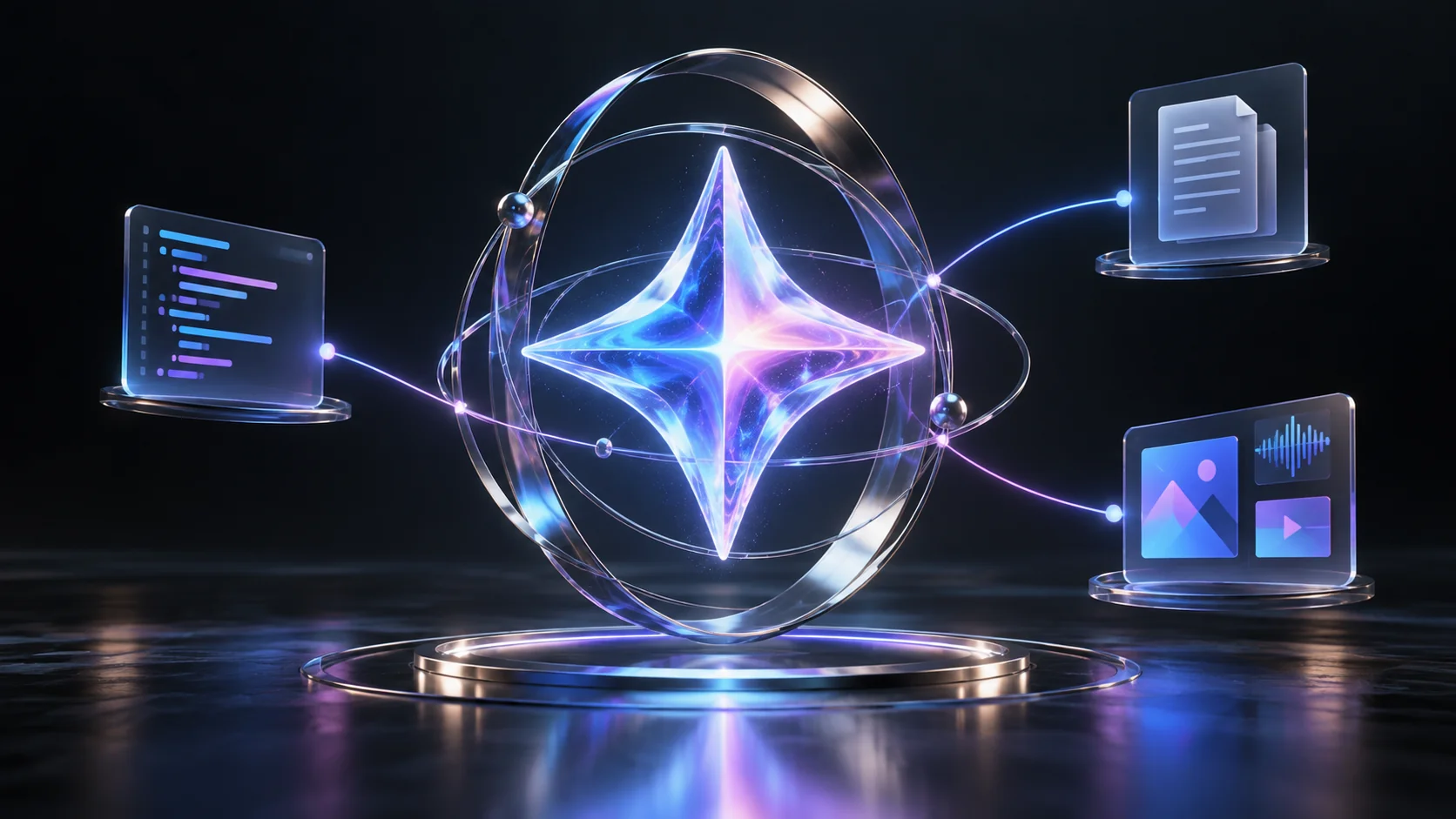
Google expanded access to Gemini 4 Argon on October 13, 2026, following its earlier introduction. The release focuses on difficult tasks that require sustained reasoning, from software engineering to research and professional document work. Google's global availability announcement describes access across developer, enterprise and consumer products.
Here are the main capabilities, where to try them, and what they mean for teams building digital products. Availability details below reflect Google's announcements as of October 14, 2026.
Gemini 4 Argon at a glance
| Detail | Confirmed information |
|---|---|
| Public rollout | October 13, 2026 |
| Model family | Google Gemini 4 |
| Inputs | Text, images, audio and video |
| Output | Text |
| Context window | Up to 1 million tokens shared between input and output |
| Main workflows | Reasoning, coding, document analysis and agentic tasks |
Sources: Google's rollout announcement and DeepMind's technical model card.
What is Gemini 4 Argon?
Argon is a reasoning model in Google's Gemini 4 family. According to the Google DeepMind model card, it accepts text, images, audio and video, and produces text. Its combined input-and-output context window supports up to one million tokens.
Input and generated text share that budget. Image and video inputs should not be confused with native image or video generation.
Gemini 4 Argon features and capabilities
Reasoning across longer workflows
Google positions Argon for problems that need multiple connected steps. Its launch examples span enterprise analysis, scientific research and complex engineering. The practical opportunity is to keep more of a task's context together while working toward a result. Those examples demonstrate Google's intended uses; they do not establish how well it will perform on your own workload. See the launch overview.
Coding and development support
Google's developer announcement highlights code migrations and other extended engineering tasks. Developers can access Argon through the paid Gemini API tier; Google also describes access through AI Studio and its Antigravity development platform for AI Ultra subscribers.
For a product team, a useful evaluation would be a bounded migration: supply the relevant code, define the expected behavior, and assess the resulting changes against existing tests. Review the diff for scope, maintainability and correctness before accepting it.
Multimodal understanding and large context
Text, screenshots, audio and video can provide different evidence about the same problem. For example, a team could evaluate whether Argon can reconcile a written requirement with a screen recording of a broken interaction. This is a suggested test, not a reported product benchmark.
The model card documents the supported inputs and context window. Large context capacity still needs careful input selection: clearly label sources and ask the model to identify which evidence supports each conclusion.
Tasks, app connections and clearer responses
The Gemini app update introduces a chat-to-tasks toggle so Gemini can continue work while the user is away. Google also reports connections to more than 40 apps, with examples including Instacart, OpenTable, Adobe and Shopify.
The same announcement describes more direct answers, less repetition and better progress updates during longer work. It also brings Antigravity's coding interface into the Gemini macOS app. These are app-level experiences; an API integration does not automatically include the same interface or connected services.
Gemini 4 Argon availability: app, API and enterprise access
Google's announcements describe these routes:
| Audience | Access route |
|---|---|
| Everyday users | Gemini app and AI Mode in Search for Google AI Pro and Ultra subscribers |
| Developers | Paid Gemini API tier; AI Studio and Antigravity access described for AI Ultra subscribers |
| Enterprises | Gemini for business, the API and Antigravity |
Check the relevant product before planning a rollout: subscription access and API access are separate routes. Sources: consumer rollout, developer rollout and enterprise availability.
Safety and practical limits
Google's safety announcement describes defenses against misuse, prompt injection and agents taking unauthorized shortcuts. It also explains the Fairwind Program for trusted cybersecurity defenders. These controls are relevant when an assistant can read external content or take actions through tools.
For your own evaluation, define success before starting. Check whether the output uses the supplied evidence, respects permissions and reports failed steps accurately. Review important actions and measure completion quality alongside time and cost.
What this means for digital product teams
Argon's launch gives teams another option for evaluating AI-assisted development and document workflows. Start with one repeatable task, compare the result with your current process, and expand only when the benefit is measurable. A persuasive demonstration is a useful starting point; a reliable workflow requires evidence from your own projects.
For more ideas about applying AI to everyday work, explore our guide to AI tools for digital marketing students.
Gemini 4 Argon frequently asked questions
Does Gemini 4 Argon generate images and video?
Its documented output is text. Images and video are supported inputs. See Google DeepMind's model card.
Is Gemini 4 Argon free to use?
The announced consumer access is for Google AI Pro and Ultra subscribers, while developers can use the paid Gemini API tier. Check the app announcement and developer announcement for the relevant access route.
What does Gemini 4 Argon's one-million-token window mean?
Prompts, documents and generated text share the capacity; the limit is not an extra allowance for output alone.
How does Gemini 4 Argon compare with Meta Muse Wonder?
Both launches emphasize reasoning, coding and extended agent workflows. The most useful comparison is whether each completes your actual task correctly, within your budget and access requirements. Our Meta Muse Wonder guide explains Meta's features, pricing and model variants; this article does not report a head-to-head test.
Cover image: an original AI-generated conceptual illustration, not an official Google product image.